
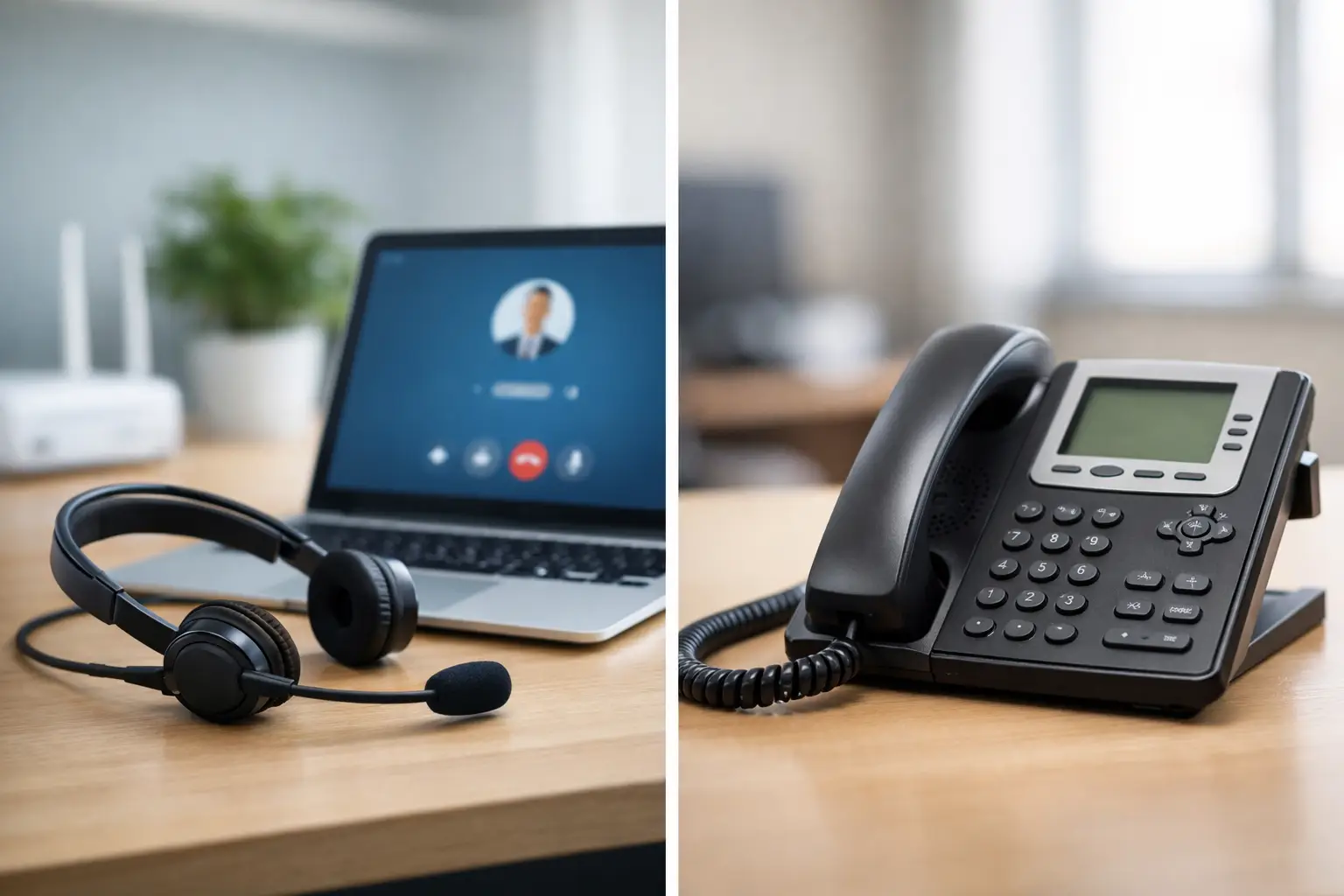
If your phones go down for even an hour, the problem usually spreads fast. Front desk staff cannot route calls, sales misses opportunities, patients or clients get frustrated, and your team starts using personal cell phones to fill the gap. That is why the choice between VoIP versus traditional phone systems is not just about monthly cost. It affects uptime, security, flexibility, and how well your business can keep operating when something goes wrong.
For small and midsize businesses, the right phone system should support daily operations without creating more risk. That means looking past marketing claims and focusing on how the system performs in real business conditions, especially if you have remote staff, compliance concerns, or limited internal IT resources.
VoIP versus traditional phone systems: the core difference
Traditional phone systems usually rely on analog lines or on-premise PBX hardware connected through the public switched telephone network. In plain terms, voice traffic travels over dedicated phone infrastructure that has been around for decades. These systems are familiar, and in some offices they are still doing the job they were installed to do years ago.
VoIP, or Voice over Internet Protocol, sends voice calls over your internet connection instead of standard phone lines. Calls are handled through IP phones, softphone apps, mobile devices, or a mix of all three. The system may be hosted in the cloud, managed on-site, or built as a hybrid setup depending on the business.
The basic difference sounds simple, but the business impact is significant. Traditional systems are often tied to a physical location and specific hardware. VoIP is usually easier to scale, easier to manage across multiple locations, and better suited to mobile or hybrid work. At the same time, VoIP depends heavily on network quality, proper configuration, and security controls.
Cost is important, but it is not the whole decision
VoIP is often promoted as the cheaper option, and in many cases it is. Long-distance calling costs are usually lower, adding users is simpler, and you can often avoid the capital expense of maintaining older PBX hardware. Moves, adds, and changes also tend to be less disruptive because they can be handled through software rather than service calls and rewiring.
That said, cost savings are not automatic. If your network is outdated, your switches are unmanaged, your firewall is poorly configured, or your internet connection is unreliable, a VoIP rollout may require infrastructure upgrades. Those upgrades are not a reason to avoid VoIP. They are a reminder that business communications should sit on a stable and secure foundation.
Traditional phone systems can appear less expensive in the short term if the equipment is already in place and mostly working. But aging phone hardware often brings hidden costs. Replacement parts become harder to source, vendor support may be limited, and basic changes can require more labor than they should. Over time, the lower flexibility of a legacy system can become more expensive than the monthly bill suggests.
Reliability depends on what is supporting the system
Many business owners still assume traditional phones are more reliable because they feel independent from the internet. That used to be a stronger argument than it is now. Modern business operations already depend on internet connectivity for email, cloud apps, document management, remote access, and line-of-business software. In most offices, communications and IT are no longer separate issues.
A traditional system can still be a solid fit in environments where analog lines serve a specific operational purpose, or where there is little need for mobility and advanced call routing. But old phone infrastructure is not immune to outages, carrier problems, or hardware failure.
VoIP reliability comes down to design. If the network is properly configured with quality of service, business-grade internet, secure firewall rules, battery backup, and failover planning, VoIP can be highly dependable. It also offers an advantage traditional systems often cannot match: calls can be redirected quickly to other devices or locations if the office loses power or access.
For many organizations, that flexibility matters more than nostalgia for older phone lines. A business continuity plan should account for weather events, ISP outages, office closures, and staffing disruptions. VoIP usually gives you more options when the unexpected happens.
Security is where the conversation gets more serious
Phone systems are often overlooked in cybersecurity planning, and that is a mistake. Attackers know that voice systems can be entry points for toll fraud, phishing, account compromise, and lateral movement across a network. Any decision about VoIP versus traditional phone systems should include a realistic security review.
Traditional systems are not automatically secure just because they are older. Legacy PBX systems can have weak access controls, outdated management interfaces, and unsupported components. If they are connected to modern networks in an ad hoc way, the risks can increase.
VoIP introduces different exposures because it operates over IP networks. Without the right protections, businesses can face issues such as unauthorized account access, poor segmentation, insecure remote devices, and misconfigured firewalls. That is why implementation matters. A secure VoIP environment should include strong password policies, multifactor authentication where available, network segmentation, encrypted signaling and media when supported, regular firmware updates, and documented admin access.
For medical, legal, financial, and municipal organizations, this matters even more. Phone systems may not be the first thing that comes up in an audit conversation, but they are part of the broader security picture. If your communication platform is loosely managed, it can undermine otherwise solid IT controls.
Features matter when they solve a business problem
Many traditional systems handle basic inbound and outbound calling well. If your office has a stable staff, one location, and simple call routing, that may be enough. But many businesses have outgrown that model without fully realizing it.
VoIP platforms usually offer voicemail to email, auto attendants, call recording, hunt groups, mobile apps, presence indicators, after-hours routing, direct extension management, and analytics. Those features are not just convenient. They can improve customer response times, reduce missed calls, and help management see where communication bottlenecks are happening.
The key question is not whether a system has more features. It is whether those features support how your business actually operates. A dental office may need dependable call routing and message handling across front desk staff. A law firm may need remote availability and reliable transfer between offices. A CPA firm may care more about seasonal scalability and call continuity during deadline periods.
The best phone system is the one that fits the workflow, not the one with the longest feature sheet.
VoIP versus traditional phone systems for growing businesses
Growth tends to expose the limits of older phone systems quickly. Adding new staff, opening a second location, supporting remote employees, or changing office layouts can become a slow process on a traditional platform. Businesses end up working around the system instead of using it efficiently.
VoIP is usually better suited for change. New users can often be added without major hardware work. Remote employees can use business numbers from approved devices. Multi-site organizations can manage call flow centrally. If your company is planning expansion, office moves, or a more flexible workforce, VoIP often aligns better with where operations are heading.
Still, there are cases where a hybrid model makes sense. Some businesses keep analog lines for faxing, alarm systems, elevator phones, or other specialty devices while moving primary voice traffic to VoIP. That approach can reduce disruption while preserving systems that still serve a valid purpose.
How to decide what fits your business
A good phone decision starts with honest assessment. Look at how calls are handled today, what downtime would cost, how many users need mobility, whether your internet and network can support voice traffic properly, and what security controls are in place.
It also helps to ask harder questions. If the current system failed tomorrow, how quickly could you recover? If your office had to close for two days, could your staff still answer calls professionally? If an employee left suddenly, how easily could you secure accounts and reroute communications? Those questions usually reveal more than a price quote does.
For businesses in the Chicago suburbs, especially those with compliance needs or limited in-house IT capacity, the phone system should be treated as part of the broader infrastructure plan. That means evaluating cabling, firewall rules, switch performance, wireless coverage, backup power, and vendor support together rather than in isolation. Tomorrow’s Solutions often sees communication issues traced back to network design problems rather than the phone platform itself.
There is no universal winner in VoIP versus traditional phone systems. The better choice depends on your environment, risk tolerance, workflow, and growth plans. But for most organizations that value flexibility, easier management, and stronger continuity options, VoIP is usually the more practical long-term direction when it is deployed correctly and secured properly.
Before making a change, take the time to assess the whole picture, not just the handset on the desk. A phone system should help your business stay reachable, organized, and resilient when the day gets messy.