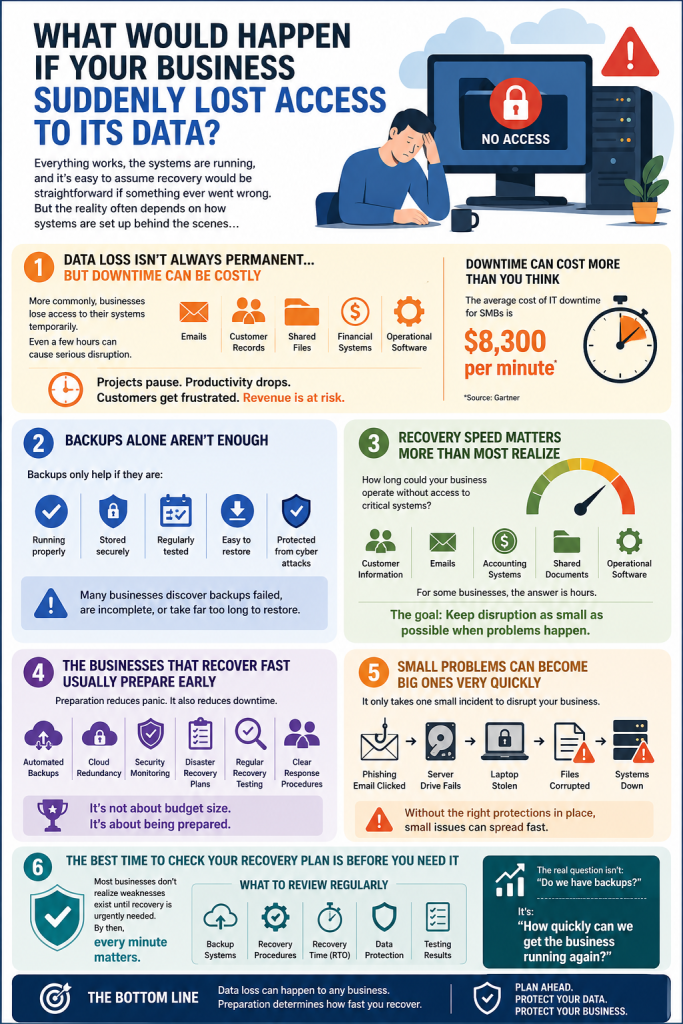

It’s not something most businesses think about every day.
Your team logs in, systems are running, files are accessible, and work gets done. Everything feels stable… until something unexpected happens.
A cyber attack. A hardware failure. An accidental deletion. Even a power issue or software error.
Suddenly, critical data becomes unavailable.
And that’s when many businesses discover the difference between having data and being able to recover it quickly.
Data Loss Isn’t Always Permanent… But Downtime Can Be Costly
When people hear “data loss,” they often imagine files disappearing forever. Sometimes that happens. But more commonly, businesses lose access to their systems temporarily.
Even a few hours without access to emails, customer records, shared files, or financial systems can create serious disruption.
Projects pause. Staff lose productivity. Customer service slows down. Revenue opportunities can disappear surprisingly fast.
The bigger issue is usually not whether recovery is possible… but how long it takes.
Backups Alone Aren’t Enough
A lot of businesses assume they’re protected because backups exist somewhere.
But backups only help if they are:
- Running properly
- Stored securely
- Regularly tested
- Easy to restore
- Protected from cyber attacks
This is where many companies run into problems.
Some discover their backups failed weeks ago. Others realize restoring data takes far longer than expected. In some cases, backups are connected to the same systems affected by ransomware, making recovery even harder.
A backup strategy should never be treated as a “set and forget” system.
Recovery Speed Matters More Than Most Businesses Realize
Imagine your systems going offline on a Monday morning.
How long could your business realistically operate without access to:
- Customer information?
- Emails?
- Accounting systems?
- Shared documents?
- Operational software?
For some businesses, the answer is hours.
That’s why modern IT planning focuses not just on backups, but also on recovery time and business continuity.
The goal is simple:
Keep disruption as small as possible when problems happen.
The Businesses That Recover Fast Usually Prepare Early
The companies that handle outages best are rarely the ones with the biggest budgets.
They’re usually the ones that planned ahead.
That includes:
- Automated backup systems
- Cloud redundancy
- Security monitoring
- Disaster recovery plans
- Regular recovery testing
- Clear response procedures
Preparation reduces panic. It also reduces downtime.
Small Problems Can Become Big Ones Very Quickly
Sometimes data loss starts with something minor:
- An employee clicks a phishing email
- A server drive fails
- A laptop gets stolen
- Software corrupts shared files
Without the right protections in place, those small issues can spread quickly across a business.
That’s why proactive IT management matters so much. The earlier risks are identified, the easier they are to contain.
The Best Time To Check Your Recovery Plan Is Before You Need It
Most businesses don’t realize weaknesses exist until recovery is urgently needed.
By then, every minute matters.
Reviewing backup systems, testing recovery procedures, and understanding how quickly operations can be restored are all essential parts of modern business resilience.
Because when access to data suddenly disappears, the real question isn’t:
“Do we have backups?”
It’s:
“How quickly can we get the business running again?”