
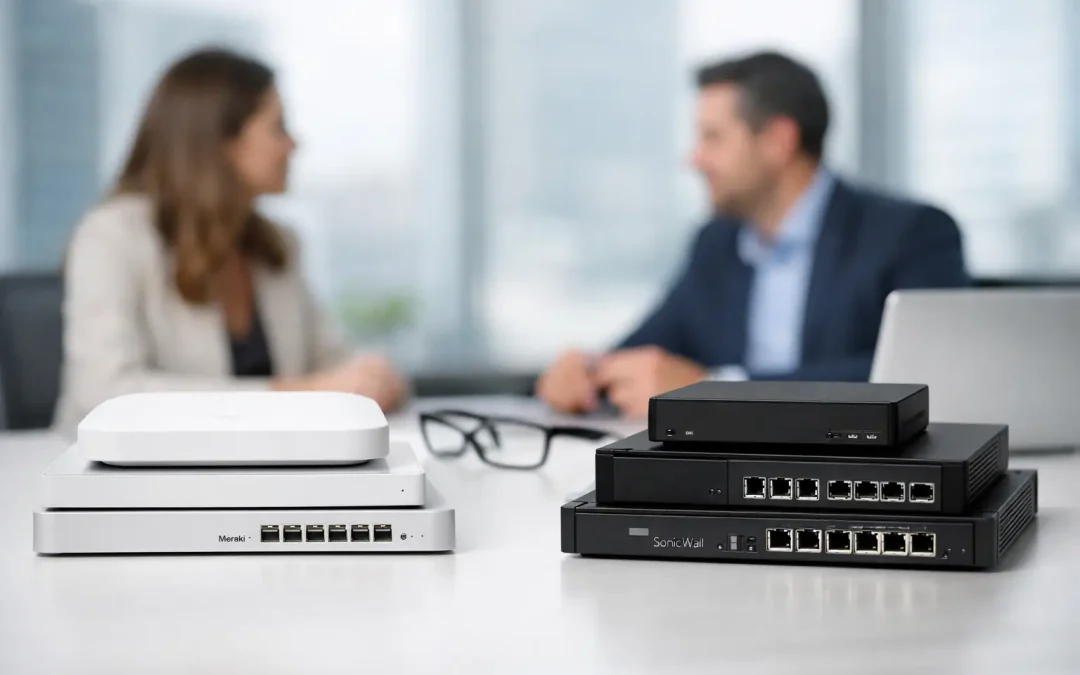
A firewall decision often gets attention only after a failed VPN connection, suspicious login alert, or ransomware scare. For businesses comparing Meraki vs SonicWall for SMB environments, the better choice is not simply the device with the longer feature list. It is the platform your team can manage consistently, monitor effectively, and scale without creating security gaps.
Both Meraki and SonicWall are proven options for small and midsize businesses. Both can protect internet connections, inspect traffic, support remote users, connect multiple offices, and provide reporting for security reviews. The difference is in how they are managed, licensed, deployed, and supported over time.
Meraki vs SonicWall for SMB: The Core Difference
Meraki is designed around centralized cloud management. Its MX security appliances are configured and monitored through the Meraki Dashboard, a web-based portal that gives IT teams visibility across locations, users, networks, and security events. For an organization with a main office, a satellite office, and remote employees, that single-pane management approach can reduce day-to-day administration.
SonicWall takes a more traditional firewall approach, with powerful local management and optional cloud-based management through SonicWall Network Security Manager. SonicWall firewalls are widely used by businesses that want detailed policy control, strong security services, and flexible deployment options without depending as heavily on a cloud dashboard for every administrative task.
Neither approach is automatically better. A dental office with one location and a limited technology budget may value SonicWall’s control and cost flexibility. A CPA firm with multiple offices, frequent staff turnover, and no internal IT department may benefit from Meraki’s easier centralized administration.
Management and Day-to-Day Support
For many SMBs, management is the deciding factor because a firewall is only useful when it is maintained. Security subscriptions must be current. Firmware must be reviewed and scheduled. VPN users need to be added and removed promptly. Alerts need someone to investigate them.
Where Meraki Is Strong
Meraki is often easier for business owners and IT providers to manage across multiple sites. The dashboard is clear, consistent, and accessible from anywhere with authorized access. It can simplify tasks such as reviewing device status, checking WAN performance, creating site-to-site VPN connections, and applying standard policies to several locations.
Meraki’s Auto VPN capability is especially useful for organizations with more than one office. Instead of manually building and troubleshooting tunnels between each location, administrators can create encrypted connections through the dashboard. This can save meaningful deployment time for offices that need shared access to servers, phone systems, or line-of-business applications.
The trade-off is that Meraki’s cloud-based model requires active licensing. If licensing is allowed to expire, the operational impact can be significant. A business needs a clear renewal process and should treat the subscription as a required operating expense, not an optional add-on.
Where SonicWall Is Strong
SonicWall is a familiar choice for businesses that want granular firewall configuration and local control. Its interface gives experienced administrators deep visibility into rules, zones, security services, routing, VPN settings, and traffic behavior. That flexibility is valuable when an office has unusual application requirements, separate networks for devices, or more complicated access rules.
A SonicWall can also be a practical fit for a single-location business that needs a capable firewall without the same level of cloud-management dependency. Properly configured, it can provide strong perimeter security, content filtering, intrusion prevention, secure remote access, and network segmentation.
The trade-off is administrative complexity. SonicWall is not difficult for a trained technician, but it is less forgiving when changes are made without documentation or a clear security plan. A rule created to solve one urgent access problem can create unnecessary exposure if it is not reviewed later.
Security Features Matter More Than the Appliance Name
Both vendors offer next-generation firewall capabilities, but the effectiveness of those capabilities depends on configuration. Turning on security services is not the same as creating a defensible network.
A properly deployed firewall should separate business workstations from guest Wi-Fi, VoIP phones, cameras, printers, and other connected devices. It should restrict unnecessary outbound traffic, block known malicious activity, protect remote access with multifactor authentication, and log events that need investigation. It should also be backed by tested backups and endpoint protection. Firewalls reduce risk, but they do not replace a complete ransomware protection plan.
Meraki is well suited to businesses that want clear visibility and standardized policies across locations. It can be particularly effective when paired with Meraki switches and wireless access points, since the entire network can be managed through one platform. This can make it easier to identify a failing connection, locate a device, or apply a guest wireless policy consistently.
SonicWall is well suited to businesses that require more detailed control over traffic and security policies. It is common in professional services, healthcare, and municipal environments where administrators need to accommodate specialized software, segmented networks, and compliance-related documentation.
For either platform, remote access deserves special attention. A VPN should never be treated as a set-it-and-forget-it service. Former employees must be removed immediately, weak passwords must be eliminated, multifactor authentication should be required where possible, and access should be limited to the systems each user actually needs.
Cost: Compare the Full Lifecycle, Not the Hardware Price
The upfront appliance cost is only one part of the decision. A realistic comparison includes the firewall, security subscriptions, licensing renewals, installation, configuration, monitoring, firmware maintenance, replacement coverage, and the labor required to support the environment.
Meraki can appear more expensive at the start because licensing is inseparable from the product experience. However, that cost may be justified if centralized management reduces support time, especially across several sites. For an organization with limited internal IT resources, fewer manual configuration tasks can mean lower operational risk.
SonicWall often offers more flexibility in how businesses combine hardware, support, and security services. It can be cost-effective when the business has a stable single-site environment and access to an experienced IT partner. However, the apparent savings disappear quickly if the firewall is not monitored, subscriptions lapse, or configurations become difficult to maintain.
Do not select either platform based on a low hardware quote alone. Ask what security services are included, how long they are active, what renewal costs will look like, and who will respond when the internet connection or VPN fails after hours.
Which Businesses Usually Fit Meraki?
Meraki is often a strong option for multi-location businesses, organizations with standardized network hardware, and companies that need simple centralized visibility. It can work well for accounting firms, hospitality groups, distributed offices, and service businesses that want an IT provider to manage locations efficiently from a central dashboard.
It is also a practical choice when network reliability is a priority and the business wants easier visibility into ISP performance. If users regularly report that “the internet is slow,” dashboard data can help distinguish a Wi-Fi issue, a bandwidth issue, or an application issue before valuable time is lost.
Meraki may be less attractive for a business that wants to minimize recurring licensing obligations or needs highly customized firewall behavior that requires extensive low-level tuning.
Which Businesses Usually Fit SonicWall?
SonicWall is often a strong fit for single-office SMBs, businesses with specific security policy requirements, and organizations that need detailed network segmentation. It is widely deployed in environments that have servers, specialized applications, compliance obligations, and a need for carefully controlled access between devices and departments.
It can also be a sensible choice for businesses replacing an older SonicWall. Existing policy structures, VPN workflows, and staff familiarity may make a well-planned upgrade less disruptive than moving to a new platform.
SonicWall may be less attractive when a business has several locations but no one available to maintain consistent settings, review logs, and document changes. More control is valuable only when someone is accountable for using it correctly.
Start With the Business Risk, Not the Brand
The best firewall recommendation starts with an assessment of how your business operates. Count locations and remote users. Identify where sensitive data is stored. Review current VPN access, wireless networks, backups, endpoint protection, and compliance requirements. Then evaluate the quality and age of the existing internet connection, switches, wireless access points, and cabling.
For Chicago-area businesses, a firewall project is also a good time to document network equipment, passwords, ISP details, and recovery procedures. That documentation becomes essential during an outage, a security incident, an office move, or an audit.
Tomorrow’s Solutions helps businesses evaluate, deploy, and maintain both Meraki and SonicWall environments based on practical security and support needs. The right answer should make remote work safer, downtime easier to prevent, and future growth easier to support.
Before choosing a platform, ask one final question: who will own the firewall after installation? The best appliance is the one that remains patched, monitored, documented, and aligned with the way your business actually works.