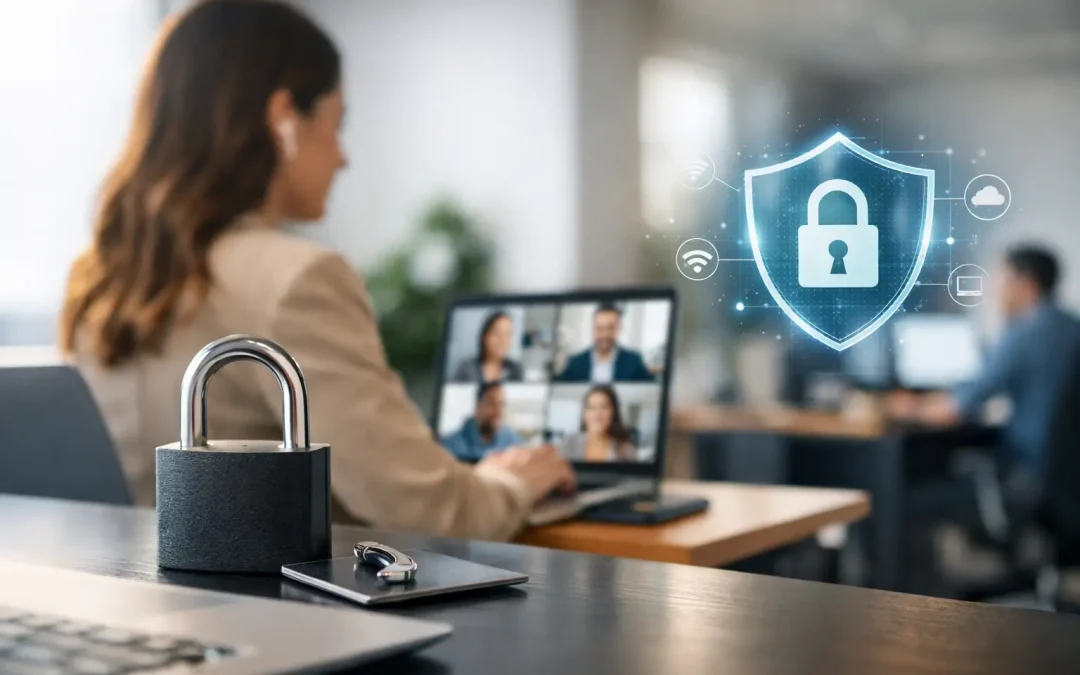
A single employee logging in from home on a personal Wi-Fi network can bypass more of your security controls than most business owners realize. That is why hybrid work security trends matter so much right now. For small and midsize businesses, the shift is no longer about supporting remote access as a temporary fix. It is about protecting users, devices, data, and cloud systems in an environment that changes every day.
For companies with lean internal IT resources, hybrid work creates a specific kind of risk. Staff move between the office, home, client sites, and mobile devices. Files live in Microsoft 365, line-of-business applications, local shares, and cloud storage. Security policies that worked when everyone sat behind the same firewall often do not hold up under those conditions.
Why hybrid work security trends are changing
The biggest shift is that the network perimeter means less than it used to. Years ago, much of your protection depended on what happened inside your office. Now users connect from many locations, on many devices, to many cloud platforms. Security has to follow the user, not just the building.
That changes purchasing decisions, policy decisions, and support expectations. It also changes how incidents happen. A ransomware event may start with a phishing email opened on a laptop at home. An account compromise may begin with weak password reuse in a cloud app that never touches your local server. A compliance failure may come from poor documentation around remote access, device control, or user permissions.
The practical takeaway is simple. Businesses need layered security that covers identity, endpoints, email, remote access, backup, and monitoring. There is no single product that solves hybrid work risk by itself.
Trend 1: Identity security is now the front line
Passwords alone are not enough, and most business owners already know that. What has changed is how central identity has become. When employees work in a hybrid model, Microsoft 365 accounts, VPN credentials, cloud applications, and remote desktop tools become prime targets.
Multi-factor authentication is now a baseline control, not an advanced option. The stronger approach goes further by using conditional access, login risk policies, and tighter control over who can sign in, from where, and on what device. This is especially important for firms handling financial records, patient information, legal documents, or municipal data.
There is a trade-off here. More identity controls can create more friction for users. If policies are too loose, risk goes up. If they are too strict, employees look for workarounds. Good security planning balances both.
Trend 2: Endpoint protection is replacing office-only assumptions
In a hybrid environment, the laptop is often the new office. That makes endpoint security one of the most important parts of the stack. Businesses are moving away from basic antivirus and toward managed endpoint detection and response, stronger patch management, device encryption, and centralized monitoring.
This matters because remote devices do not always receive the same attention as office workstations. Some go weeks without connecting to the company network. Some are shared improperly. Some run outdated software because no one is enforcing updates consistently.
The trend is not just more software on devices. It is more visibility into device health, suspicious behavior, and missing updates. For smaller organizations, this is where managed IT support can make a measurable difference. If nobody is actively watching endpoint alerts, tools alone do not reduce much risk.
Trend 3: Zero trust is becoming practical for SMBs
Zero trust used to sound like an enterprise-only concept. Now it is showing up in practical ways for smaller businesses. The idea is straightforward: do not automatically trust a user or device just because it is inside your network or connected through a VPN.
In practice, that means verifying identity, checking device compliance, limiting access by role, and segmenting systems so one compromised account does not expose everything. A dental office does not need every staff member to have broad access to every file share. A CPA firm should not rely on old flat network design if sensitive client data is spread across too many systems.
This trend does not require a complete rebuild overnight. In many environments, it starts with better account permissions, stronger MFA, network segmentation, and stricter remote access controls. The key is reducing unnecessary trust points.
Trend 4: Email and collaboration tools remain the easiest entry point
Most hybrid work incidents still begin with a person. Email phishing, malicious attachments, fake login pages, and business email compromise remain common because they work. Collaboration platforms have also expanded the attack surface. Teams messages, file-sharing links, and shared cloud folders can all be abused if controls are weak.
That is why one of the strongest hybrid work security trends is the shift toward layered email security. Businesses are adding advanced filtering, impersonation protection, attachment sandboxing, and user awareness training. For Microsoft 365 environments, mailbox auditing, forwarding rule checks, and account anomaly reviews are also becoming more common.
User training deserves a realistic approach. Annual awareness sessions are rarely enough. Short, repeated training and phishing simulations tend to be more effective because they match how attacks actually show up – often, quickly, and without much warning.
Trend 5: Secure remote access is being re-evaluated
Many companies set up remote access quickly and never revisited the design. That is now catching up with them. Older VPN configurations, exposed remote desktop services, shared credentials, and poorly documented firewall rules create avoidable risk.
A major trend is the move toward cleaner, more controlled remote access. That can include modern VPN deployment, tighter firewall policy management, remote desktop hardening, role-based access, and better logging. Some businesses are also reducing direct network access when a cloud-based or application-specific approach makes more sense.
It depends on the environment. A manufacturer with on-premise systems may still need traditional VPN access. A professional services firm using mostly cloud applications may need less network-level access and stronger identity controls instead. The important point is not choosing the newest method. It is choosing the safest method that fits how your staff actually works.
Hybrid work security trends and compliance now overlap
For many organizations, security is no longer just about avoiding downtime. It is also about passing insurance reviews, satisfying client requirements, and meeting industry obligations. That is why hybrid work security trends increasingly overlap with compliance.
Medical, legal, accounting, and public-sector organizations are being asked tougher questions about access control, data protection, backup testing, written policies, incident response, and device management. Remote and hybrid work make those questions more urgent because the environment is harder to control without documentation and consistent standards.
This is where written security plans, password documentation procedures, backup reporting, and regular security assessments become useful operational tools, not paperwork exercises. If a business cannot explain how remote users connect, how devices are protected, or how files are recovered after an incident, it has a gap that needs attention.
Trend 6: Backup strategy is shifting from storage to recovery
A backup is only valuable if it supports recovery when systems are down and pressure is high. Hybrid work has made backup planning more complicated because data is spread across endpoints, servers, and cloud platforms. Many businesses assume Microsoft 365 or another cloud provider covers every recovery need. Often, that assumption is incomplete.
The trend is toward recovery-focused planning. That means verifying what is backed up, how quickly it can be restored, whether cloud data is protected separately, and whether ransomware can impact backup systems. It also means testing.
For SMBs, this is one of the most overlooked areas. They may have backups in place but no clear understanding of restoration timelines, retention limits, or failure points. In a real event, those details matter more than backup marketing claims.
Trend 7: Security monitoring is moving from periodic to continuous
The old model of setting up security controls and checking them occasionally is losing ground. Hybrid environments change too often. New devices appear, permissions drift, software updates fail, and unusual sign-ins happen outside business hours.
That is why continuous monitoring is becoming more important. Businesses want alerting on suspicious activity, failed backups, device issues, unauthorized access attempts, and critical vulnerabilities. They also want someone accountable for responding, not just generating reports.
For a smaller company, this can be difficult to manage internally. The volume of alerts may be low one week and urgent the next. A practical service model gives organizations a way to maintain oversight without building a full in-house security operation.
What businesses should do next
If your hybrid work setup grew organically over the past few years, now is the time to review it with a security lens. Start with identity controls, remote access, endpoint protection, email security, backups, and documentation. Then look at how those pieces connect. Gaps usually appear between systems, not just within them.
A business in Lombard, Naperville, or the surrounding Chicago suburbs does not need enterprise complexity to improve security. It needs clear priorities, tested controls, and support from technicians who understand both day-to-day operations and real business risk. That is where a practical assessment often brings the most value. It shows what is working, what is exposed, and what should be fixed first.
Hybrid work is here to stay, but risk does not have to grow with it. The companies that handle it best are not the ones buying the most tools. They are the ones putting the right controls in the right places before an incident forces the decision.