A single fraudulent email can look like a routine Microsoft 365 password notice, an invoice from a known vendor, or a request from the owner to send a wire transfer. That is why a business email security checklist must cover more than a spam filter. It needs to protect the message, the user account, the devices that access it, and the business process that turns an email into a payment, file transfer, or password reset.
For small and midsize organizations, email remains the most common entry point for phishing, business email compromise, ransomware, and account takeover. The goal is not to eliminate every suspicious message. The goal is to make a bad message difficult to deliver, difficult to act on, and easy to contain when someone makes a mistake.
Start With Email Authentication and Domain Protection
Your domain name is part of your business identity. If criminals can send messages that appear to come from your company, they can target your employees, customers, vendors, and financial contacts. Proper domain authentication reduces that risk and helps legitimate messages reach their destination.
Confirm that SPF, DKIM, and DMARC are configured for every domain your organization uses to send email. SPF identifies the mail services authorized to send on behalf of your domain. DKIM adds a digital signature that helps receiving systems verify a message has not been altered. DMARC tells receiving systems what to do when SPF or DKIM checks fail, while providing reporting that reveals unauthorized senders.
Many companies set up SPF and DKIM but leave DMARC in monitoring mode indefinitely. Monitoring is a reasonable first step because it identifies legitimate services that may have been missed, such as a marketing platform, copier scan-to-email function, or line-of-business application. After those services are validated, move toward quarantine or reject enforcement. The right timing depends on how many systems send mail for your business, but leaving DMARC unenforced permanently leaves room for impersonation.
Also register reasonable variations of your domain when the risk justifies it, and monitor for lookalike domains. A criminal does not need to duplicate your domain exactly. Replacing one character or adding a hyphen can be enough to fool a rushed employee.
Secure Every Email Account
A stolen mailbox is often more valuable to an attacker than a single infected computer. Once inside, they can read conversations, reset passwords for other services, create forwarding rules, and impersonate an employee from a legitimate account.
Require multi-factor authentication for every mailbox, especially administrators, executives, finance personnel, and remote workers. App-based authenticator prompts or hardware security keys are generally safer than text-message codes. MFA is not a complete answer, however. Attackers use fake sign-in pages and repeated prompt attacks to capture credentials or pressure users into approving a request.
Use conditional access controls where your email platform supports them. Block legacy authentication, require stronger verification for risky sign-ins, and limit access from countries where your organization does not do business when appropriate. These settings should be tuned carefully. An overly restrictive policy can disrupt a legitimate employee traveling abroad or a vendor-supported application, so document exceptions and review them regularly.
Each person should have an individual account. Shared mailboxes can be useful for addresses such as billing@ or support@, but access should be assigned to named users rather than through a shared password. Remove access promptly when roles change or employment ends.
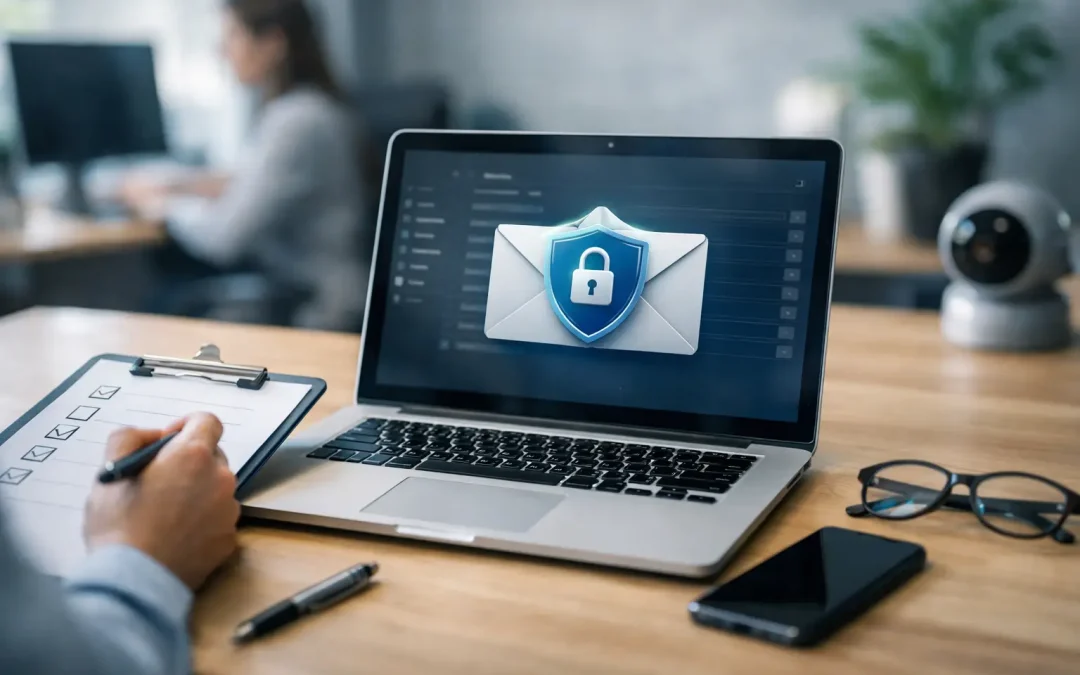
Apply This Business Email Security Checklist
Review the following controls at least quarterly, and immediately after a major email migration, security incident, or staff change:
- Enforce multi-factor authentication for all users and separate administrative accounts from daily-use accounts.
- Disable legacy email protocols and basic authentication unless a documented business requirement remains.
- Configure SPF, DKIM, and DMARC, then review DMARC reports before moving toward an enforcement policy.
- Use advanced email filtering that scans attachments, links, impersonation attempts, and newly registered or suspicious domains.
- Block automatic external forwarding unless it has been specifically approved and documented.
- Review mailbox rules, delegated access, inactive accounts, and privileged roles for unauthorized changes.
- Keep email clients, browsers, operating systems, endpoint protection, and productivity applications patched.
- Back up Microsoft 365 or other cloud email data independently when retention, recovery, or compliance needs require it.
- Train employees to recognize phishing, but give them a fast and simple method to report a suspicious message.
- Require verbal or secondary-channel verification for payment instructions, bank detail changes, gift card requests, and sensitive data requests.
The checklist is most effective when each item has an owner. A policy that says, “Review forwarding rules regularly,” is less useful than a recurring task assigned to a specific administrator or managed IT provider.
Filter Threats Without Blocking the Business
Email filtering should inspect more than obvious spam. Modern attacks often arrive from legitimate but compromised accounts, which means the sender may have a valid reputation and a believable history. Look for filtering features that evaluate impersonation, message content, attachment behavior, embedded links, and unusual sending patterns.
Quarantine settings need attention. If they are too aggressive, employees may miss legitimate customer requests or time-sensitive invoices. If they are too relaxed, malicious messages reach inboxes. Review quarantine reports and false positives during the first weeks after any major policy change. This is one area where a practical balance matters more than a one-size-fits-all setting.
External email banners can help employees pause before responding to a message from outside the organization. They are not a substitute for filtering or training, and overuse can cause banner fatigue. Still, a clear external sender notice is valuable when an attacker impersonates a coworker or executive using a personal account.
Protect the Financial and Operational Workflows
Technical controls cannot stop every social engineering attempt. Business email compromise often succeeds because an employee follows a plausible request under pressure. A message may ask accounts payable to update banking information, a receptionist to buy gift cards, or an administrator to send W-2 information.
Create written verification procedures for high-risk actions. Payment changes, wire transfers, payroll updates, and requests for confidential records should require confirmation using a known phone number or another trusted channel. Do not use the contact details included in the suspicious email.
This control should apply even when a request appears to come from the owner, a regular vendor, or a long-standing client. Attackers routinely study public websites, social media, and compromised mailbox threads to make their messages believable. A two-minute verification call can prevent a loss that email recovery cannot reverse.
Train Employees for Real Decisions
Annual slide-based training alone is rarely enough. Employees need short, recurring instruction that reflects the messages they actually receive: fake Microsoft 365 alerts, invoice scams, shared-document notifications, QR-code phishing, and requests from executives or vendors.
Phishing simulations can be helpful when used as coaching rather than punishment. Track trends by department and use results to improve training, filtering, and business processes. If several employees click the same type of message, the problem may be a confusing workflow or an email rule that needs adjustment, not simply employee carelessness.
Make reporting easy. A report-phishing button or a clearly communicated support process gives employees a safe response when they are unsure. Encourage them to report first and ask questions later. Fast reporting allows IT to remove similar messages, block malicious senders, and investigate whether anyone entered credentials.
Monitor, Respond, and Recover
Assume that a suspicious email will eventually get through. Your response plan should identify who investigates reported messages, who can disable accounts, and who contacts affected clients or vendors if an account is compromised. Keep emergency contact information available outside of email in case mail access is disrupted.
Monitor sign-in activity, risky logins, administrator changes, mailbox forwarding rules, and new application consent requests. Attackers frequently create hidden inbox rules or authorize third-party applications so they can maintain access after a password reset. Those indicators should be reviewed as part of routine security maintenance.
A tested recovery plan also matters. Know how to restore deleted emails, recover mailboxes, revoke active sessions, reset credentials, and preserve evidence for an insurance claim or compliance review. For organizations in healthcare, legal, financial, municipal, or other regulated environments, document the process and align it with applicable retention and incident-reporting requirements.
Tomorrow’s Solutions helps Chicago-area businesses assess email security, Microsoft 365 configurations, endpoint protection, and response readiness before a mailbox compromise becomes a business interruption. The best time to test these controls is during normal operations, when there is time to correct gaps without pressure.
Email security is not a product you turn on once. It is a set of technical controls, employee habits, and verification procedures that must keep pace with how your business communicates. A focused review now can make the next convincing phishing email an inconvenience instead of an incident.